An investigational drug developed using generative artificial intelligence demonstrated tumor-shrinking activity in patients with heavily pretreated mesothelioma, offering another encouraging development in the search for new treatment options.
A new investigational treatment for mesothelioma is showing promising early results in a Phase 1 clinical trial. Insilico Medicine announced that its experimental drug, ISM6331, demonstrated antitumor activity in patients with advanced mesothelioma, including individuals who had already undergone multiple lines of treatment.
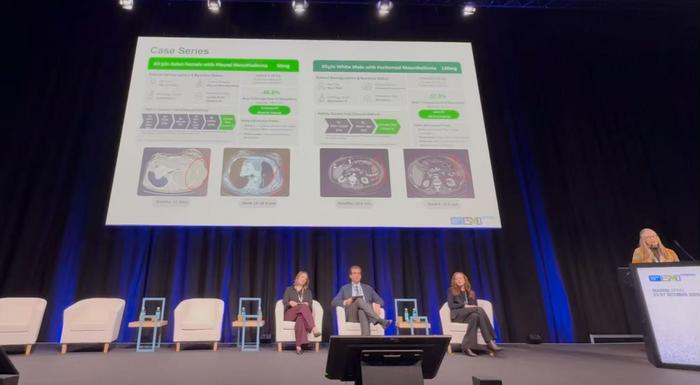
The findings were presented at the 2026 European Society for Medical Oncology (ESMO) Congress in Madrid, Spain, by foundation board member Melina Marmarelis, MD, of the Abramson Cancer Center at the University of Pennsylvania.
What makes this development particularly interesting is not only the drug’s early clinical results, but also how it was developed: using generative artificial intelligence (AI) to help design a molecule targeting a biological pathway associated with cancer growth.
Encouraging Early Results in Heavily Pretreated Patients
In the ongoing Phase 1 clinical trial, researchers evaluated ISM6331 in patients with advanced solid tumors, including mesothelioma.
Among the mesothelioma participants whose responses could be evaluated, the company reported:
- 40% objective response rate at the 130 mg dose: Two of five evaluable patients experienced a partial response, meaning their tumors shrank by at least the amount required to meet established response criteria.
- 18.2% objective response rate across dose groups: Four of 22 evaluable mesothelioma participants experienced a partial response at doses ranging from 30 mg to 130 mg.
- 68.2% disease control rate: More than two-thirds of evaluable participants experienced either tumor shrinkage or stable disease.
- Early and durable responses: Three of the four patients who experienced a partial response showed tumor shrinkage at their first eight-week scan. Additionally, three of the four partial responses were still ongoing at the time of the data cutoff, including one response that had lasted approximately one year.
Notably, some participants who experienced partial responses had already received five or six previous lines of treatment. This is particularly significant because patients with advanced mesothelioma who have exhausted multiple treatment options often have limited alternatives.
At the 130 mg dose, two participants experienced target-lesion reductions of 58% and 36%, respectively.
The findings are preliminary, and the 40% response rate reflects a small group of just five evaluable participants at that particular dose. Nevertheless, the results provide an encouraging signal that warrants further investigation.
Targeting the Hippo-TEAD Pathway
ISM6331 is an oral, investigational pan-TEAD inhibitor designed to target the Hippo signaling pathway, which plays an important role in regulating cell growth, survival, and tissue development.
The Hippo pathway helps maintain normal cellular function. When this pathway becomes disrupted, downstream proteins known as YAP and TAZ can interact with TEAD transcription factors to activate genes that promote tumor growth, survival, and resistance to treatment.
Researchers believe that targeting this pathway could offer a new approach to treating cancers, including mesothelioma, particularly in tumors where Hippo pathway signaling is disrupted.
ISM6331 is designed to inhibit all four TEAD proteins (TEAD1–4), interrupting the signals that can contribute to cancer progression.
The drug was developed using Insilico Medicine’s Chemistry42 generative AI platform. This technology uses artificial intelligence to help identify and design potential drug molecules with specific biological and chemical properties.
The development of ISM6331 represents an example of how AI-assisted drug discovery is moving beyond computer modeling and into human clinical trials.
What Do We Know About Safety?
In addition to evaluating whether the drug could shrink tumors, researchers examined its safety and tolerability.
According to the company, no dose-limiting toxicities were reported among participants receiving doses ranging from 15 mg to 130 mg. No treatment-related adverse events resulted in participants discontinuing treatment.
Most reported treatment-related side effects were mild to moderate (Grade 1 or 2). Grade 3 treatment-related adverse events occurred in 8.3% of participants and included fatigue, drug-related dermatitis, and increases in amylase and lipase levels. Low-grade, reversible proteinuria (protein in the urine) was also reported.
While these initial findings suggest a manageable safety profile, additional research involving more participants and longer follow-up will be necessary to better understand the drug’s safety.
What Happens Next?
ISM6331 is currently being evaluated in an ongoing global Phase 1 clinical trial (NCT06566079). The study is designed to assess safety, tolerability, dosing, and preliminary antitumor activity.
The company plans to complete its Phase 1 dose selection process and, depending on the emerging results, move forward with a Phase 2a randomized dose-optimization study in mesothelioma.
ISM6331 has also received both Orphan Drug Designation and Fast Track Designation from the U.S. Food and Drug Administration (FDA) for mesothelioma.
Fast Track Designation is intended to facilitate the development and review of treatments for serious conditions with unmet medical needs. It does not mean that a drug has been approved or that its effectiveness has been established.
ISM6331 remains investigational and is not currently an approved treatment for mesothelioma.
Continued Progress in Mesothelioma Research
For the mesothelioma community, every new avenue of research represents an opportunity to move closer to better treatments and longer lives.
The ISM6331 findings are particularly interesting because they involve patients who had already received multiple treatments, a population with significant unmet medical needs. While much more research is needed, the early tumor responses and ongoing disease control provide a reason to continue studying this approach.
The use of generative AI in developing ISM6331 also highlights the expanding role of innovative technologies in drug discovery. As researchers learn more about the molecular pathways that drive mesothelioma, new approaches to identifying and developing targeted treatments may become possible.
At the Mesothelioma Foundation, we remain committed to advancing research, sharing developments with our community, and ensuring patients and families have access to information about emerging treatment options and clinical trials.
To learn more about the ongoing ISM6331 clinical trial, contact our Director of Patient Services, Julie White at [email protected].
As always, patients should discuss potential clinical trial participation and treatment options with their mesothelioma care team.